Kindergarten Readiness in San Jose: A Parent’s Checklist
You know your child. You’ve watched them build towers, negotiate with a sibling, and melt down over the wrong color cup. So when someone asks, “Is she ready for kindergarten?”, the honest answer is usually somewhere between “mostly” and “I have no idea.” That uncertainty is normal, and it’s fixable.
Readiness is not about reading chapter books or doing worksheets. It is a mix of everyday skills across five areas: getting along with people, taking care of themselves, using language, playing with numbers, and moving their bodies. This guide breaks down what each one looks like in real life.
You’ll get a plain checklist you can actually use, the California age rules explained simply, and an honest look at the private versus public kindergarten choice here in San Jose.
Readiness is about habits, not academics. Teachers care more about whether a child can follow a routine and separate from you calmly than whether they can already read.
California kindergarten starts at 5. Your child generally must turn 5 by September 1 to enroll, with transitional kindergarten as a bridge for younger fours and fives.
A strong pre-K does most of the work. If your child is in a good program, the checklist below is likely already being covered every day.
What does “kindergarten ready” actually mean?
Ready doesn’t mean advanced. It means your child can function in a group of twenty-plus kids with one teacher for a full day. That’s the real bar. Kindergarten teachers will tell you they can teach letters and numbers to almost anyone. What they can’t teach quickly is how to sit in a circle, wait a turn, or ask for help.
So readiness lives in five buckets: social-emotional, self-help, language and early literacy, early math, and motor skills. A child doesn’t need to master every item. They need enough across all five to have a good first month instead of a hard one.
Social-emotional skills
This is the one that matters most, and the one worksheets ignore. Look for a child who can:
- Separate from you without a long meltdown (a few tears is fine)
- Follow a simple two-step routine, like “hang up your bag and sit down”
- Take turns and share, even if it still stings sometimes
- Ask an adult for help instead of shutting down
- Recover from a small disappointment within a few minutes
- Play alongside other kids and join a group
Self-help and independence
Kindergarten teachers don’t have time to zip twenty coats. The more your child can do alone, the smoother the day. Check whether they can:
- Use the bathroom independently, including wiping and hand washing
- Put on and take off a jacket, and manage most buttons or zippers
- Open their own lunch containers and food wrappers
- Clean up toys and put belongings where they go
- Blow their nose and manage basic needs without prompting
Language and early literacy
Talking is the foundation of reading, so conversation counts more than flashcards. Aim for a child who can:
- Speak in full sentences others can understand
- Tell a simple story with a beginning, middle, and end
- Recognize many letters and know some of the sounds they make
- Hear rhyming words and clap out syllables
- Recognize and try to write their own first name
- Follow a two- or three-step spoken direction
Early math thinking
Early math is more about patterns than arithmetic. Watch for a child who can:
- Count to at least ten or twenty out loud
- Count a small group of objects one at a time, touching each once
- Sort things by color, size, or shape
- Copy and continue a simple pattern, like red-blue-red-blue
- Understand words like more, less, first, and last
- Name basic shapes
Fine and gross motor skills
Small hands need practice before they can write, and big movements build the focus that sitting requires. Look for a child who can:
- Hold a crayon or pencil with a reasonable grip
- Use scissors to cut along a line
- Draw simple shapes and a rough person
- Run, jump, climb, and catch a large ball
- Sit still and attend to a task for ten to fifteen minutes
What age do you start kindergarten in California?
In California, a child generally must turn 5 on or before September 1 to enroll in kindergarten for that school year. If your child’s fifth birthday lands after that date, they usually wait a year or enroll in transitional kindergarten instead.
Transitional kindergarten, or TK, is a public program that acts as a bridge year for younger children. California has been expanding TK, and eligibility has widened over recent years, so it’s worth checking the current birthday windows with your district. If you are weighing that route, our guide on private preschool versus free TK in San Jose walks through the trade-offs.
Age is a rule, not a readiness test. Some kids clear the September 1 cutoff by a week and are more than ready. Others are older and still need time. Use the checklist above, and trust what you see day to day over the number on the calendar.
How do I know if my child is ready for kindergarten?
Sit with the checklist and mark each item as “yes,” “sometimes,” or “not yet.” You’re not scoring a test. You’re looking for patterns. A child with mostly yeses and a handful of “sometimes” is in good shape. A child with lots of “not yets” clustered in one area tells you where to spend the spring before school starts.
Pay closest attention to the social-emotional and self-help buckets. A child who can regulate their emotions and handle a bathroom trip alone will usually catch up on letters fast. The reverse is harder. An early reader who falls apart when you leave will have a rough start no matter how many sight words they know.
Talk to the people who see your child in a group. A preschool teacher watches your child do the exact things kindergarten will ask for, all day, alongside peers. Their read is often more useful than anything you can test at your kitchen table.
How does a strong pre-K prepare a child?
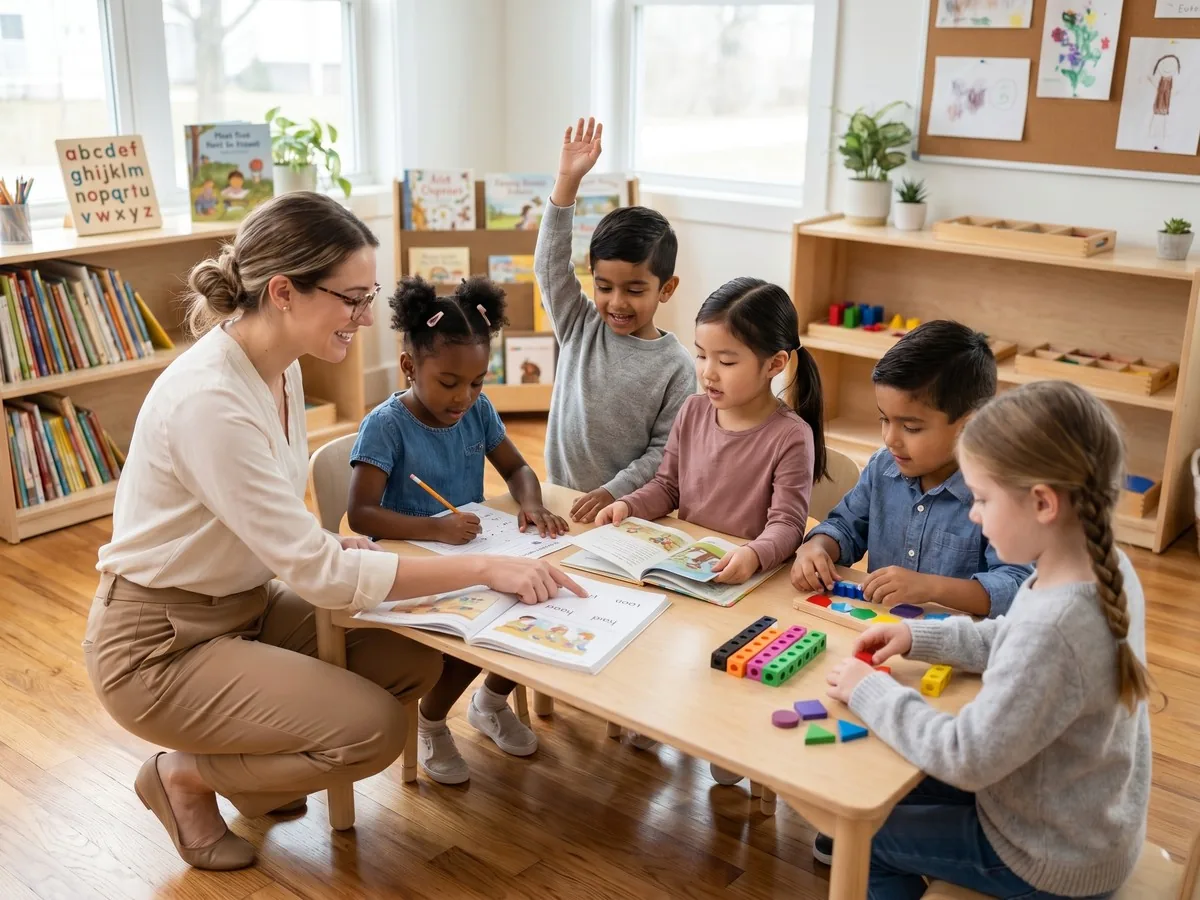
A good pre-K program covers this whole checklist without anyone calling it “kindergarten prep.” Circle time builds attention and turn-taking. Snack builds independence. Story time builds literacy. Free play builds the negotiation and recovery skills that make group life work.
That’s why the pre-K year matters so much. Children who spend it in a structured, play-based classroom arrive already fluent in the routines of school. They know how to line up, how to raise a hand, and how to move through a day that is not built around them alone. If you are still sorting out programs, see daycare versus preschool versus pre-K in San Jose.
Private versus public kindergarten in San Jose
Once a child is ready, you face a second choice: private or public kindergarten. Public kindergarten is free and tied to your neighborhood school, with larger classes and a set district calendar. Private kindergarten usually means smaller classes, a longer day that fits working parents, and more flexibility in curriculum, but it isn’t free.
There’s no universally right answer. Some families want the neighborhood cohort their child will stay with for years. Others want the smaller setting and continuity of care. Weigh class size, daily hours, calendar, and whether your child would have to change buildings and friend groups midstream.
Where Building Kidz fits
Building Kidz of San Jose runs a private kindergarten on the same Cambrian campus as its preschool and pre-K classrooms, at 4115 Jacksol Drive next to Houge Park. That matters for one practical reason: a child who is already enrolled can move up to kindergarten without switching schools, meeting new teachers, or leaving the friends they have known for years.
The daily approach is built to cover the readiness checklist naturally. Every classroom includes English and Spanish immersion at no added fee, plus a STEAM performing-arts curriculum that builds the confidence, language, and turn-taking this guide is all about. The school is family-owned, has been open since 2019, keeps small ratios, and runs full-day, year-round hours for working families. It also accepts several childcare subsidies, so don’t rule out private care on price before you check. The clearest way to judge fit is a short tour. You can see how the kindergarten day flows and ask how they would handle your specific child.
See Building Kidz of San Jose for yourself. Tour the campus beside Houge Park, meet the teachers, and get a tuition figure tailored to your child’s age and any subsidy you qualify for. Tours run Monday to Friday at 9:30 AM, 10:30 AM, or 3:00 PM.
Schedule a Tour or call (408) 559-1003
Frequently Asked Questions
What skills does a child need for kindergarten?
A child needs a spread of everyday skills, not academics. The core ones are separating from you calmly, following a two-step routine, taking turns, using the bathroom alone, speaking in full sentences, recognizing letters and some sounds, counting small groups, and holding a pencil. Social and self-help skills matter most, because teachers can teach letters faster than self-regulation.
What age do you start kindergarten in California?
In California, a child generally must turn 5 on or before September 1 to start kindergarten that school year. Children whose birthdays fall after the cutoff often enroll in transitional kindergarten, a public bridge program, or wait a year. Eligibility windows for TK have widened recently, so confirm the current dates with your local district.
How do I know if my child is ready for kindergarten?
Work through a readiness checklist and mark each skill as yes, sometimes, or not yet. Look for patterns rather than a perfect score. Focus on social-emotional and self-help skills first, since those predict a smooth start best. Ask your child’s preschool teacher, who watches them handle group routines every day, for an honest read.
Should I choose private or public kindergarten?
It depends on your priorities. Public kindergarten is free, neighborhood-based, and has larger classes on a district calendar. Private kindergarten usually offers smaller classes, longer hours for working parents, and curriculum flexibility, but it charges tuition. Weigh class size, daily hours, calendar fit, and whether your child would have to change schools and friend groups.
Does Building Kidz offer kindergarten?
Yes. Building Kidz of San Jose offers a private kindergarten on the same Cambrian campus as its preschool and pre-K rooms. Because it shares a campus, children already enrolled can move up without changing schools or leaving their friends. The kindergarten keeps the school’s small ratios, bilingual immersion, and performing-arts curriculum. Book a tour to see the classroom.
Can my child start kindergarten if they are not fully ready?
Sometimes, yes. Meeting the September 1 age cutoff makes a child eligible, but readiness varies. If several checklist items are still “not yet,” talk with your preschool and prospective school about options, including an extra pre-K year or transitional kindergarten. A strong pre-K year usually closes most gaps before the first day.