Infant and Toddler Care in San Jose: A Guide for Ages 6 Months to 3 Years
Most San Jose parents start looking for infant care the month they find out they are pregnant, and they are still looking eight months later. There’s far less licensed care for babies than there is for four-year-olds, and a lot of the schools that come up in a search don’t actually take children under two.
That gap catches families off guard. You call ten places, six are preschools that start at two or three, two have a waiting list measured in quarters, and the rest never call back. Meanwhile your leave is ending.
So here’s what’s actually available for babies and toddlers in San Jose, what changes between the infant room and the toddler room, what to look at on a tour when your child can’t tell you how the day went, and how to compare real cost without getting lost in add-on fees.
Check the age minimum first. Plenty of San Jose preschools don’t enroll until two or three. Filter for a licensed infant room before you fall in love with a campus.
Ratios matter more than almost anything else under three. How many babies one adult is responsible for shapes the whole day.
Start earlier than feels reasonable. Infant rooms are the smallest rooms in any school, so there are fewer spaces and they move slowly.
Where can I find infant care starting at 6 months in San Jose?
You need a center licensed by California specifically for infants, which is a different license category from preschool, and in San Jose those are the minority. Plenty of well-known schools in the area start at two. A smaller group takes babies from six weeks to six months. Building Kidz of San Jose is in that second group and enrolls infants from six months.
So reverse the search. Instead of hunting for the best preschool near you and then asking about age, ask about age first. Call and lead with the question: what is the youngest age you accept, and do you have a licensed infant room. That one question cuts a list of thirty schools down to a handful in an afternoon.
Why the six month mark matters
Six months lines up with the end of a typical California parental leave, and it is also the point where many babies are sitting up, starting solids, and ready for more social and sensory input than a home setting usually provides. A program that starts at six months means you’re not stitching together a nanny share or a grandparent rotation for eighteen months and then starting the search over.
Continuity is the hidden benefit
There’s a second reason to care about the starting age. Place your baby at six months in a school that runs through kindergarten and you’re done. No new search at two, no new search at four, no new set of teachers to trust. Your child moves rooms, but the building, the director, and the families around them stay the same.
What is the difference between an infant room and a toddler room?
The infant room is built for babies still on their own schedules. The toddler room is built for children who are mobile and starting to test limits. The shift usually happens somewhere between twelve and eighteen months, and a good school moves your child when they are ready, not on their birthday.
What the infant day looks like
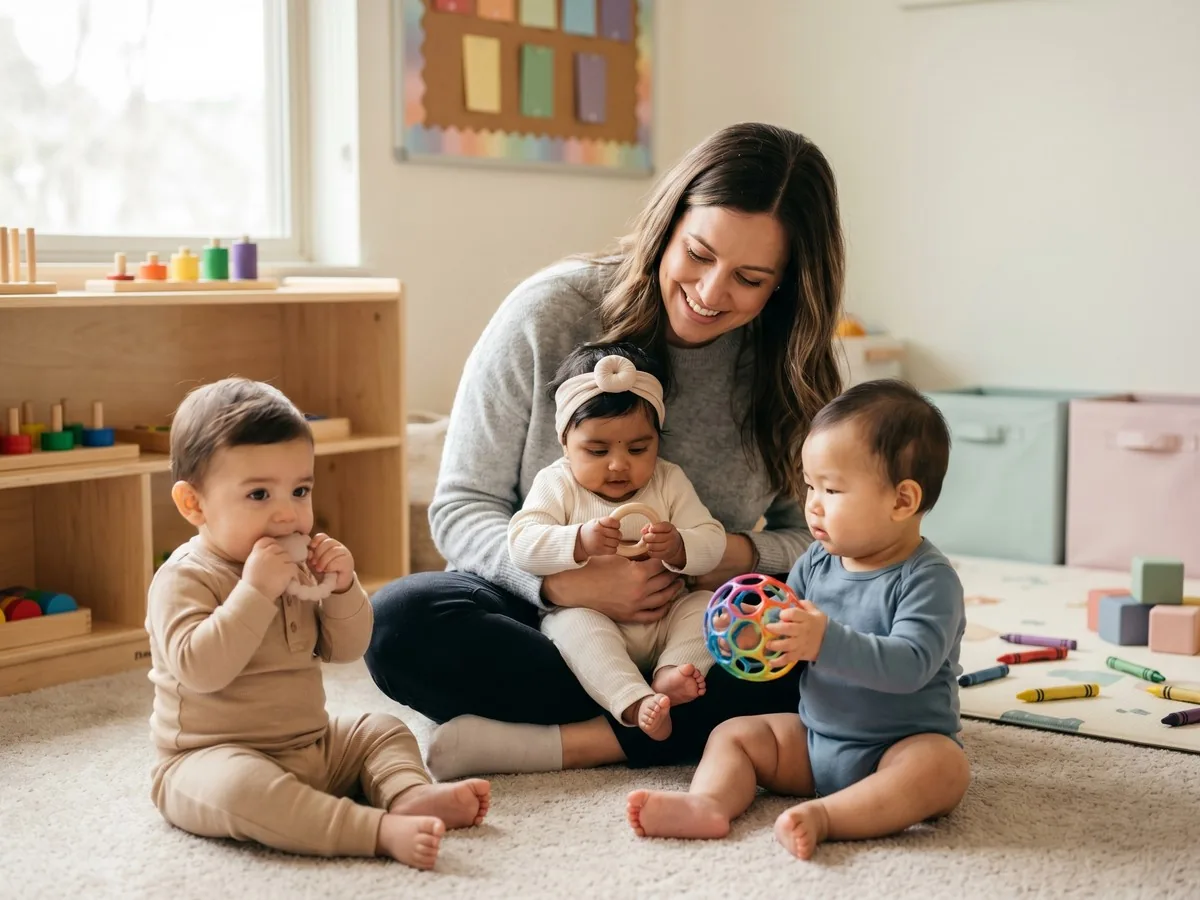
Infant care follows your baby, not a bell. Feeding, napping, and diapering happen on your child’s schedule and get logged. In between, the work is sensory and one-on-one: tummy time, board books read out loud, music, texture play, and a lot of talking. It looks unstructured from the doorway. It isn’t. At this age the talking is the curriculum.
At Building Kidz the infant room is called Minnows Infant and runs from six through fourteen months, at a ratio of one teacher to three children.
What the toddler day looks like
Toddlers need room and a yes-space. The classroom gets rebuilt around their bodies: low furniture, safe climbing, gates in the right places, and materials they are allowed to get messy with. The curriculum shifts toward independence, gross motor work, and early language. Play-Doh, paint, and outdoor equipment sized for short legs do more developmental work than any worksheet at this age.
The Building Kidz toddler room, Minnows Toddler, runs fifteen to twenty-four months and holds the same one to three ratio as the infant room. The close support doesn’t drop away the moment a child learns to walk.
Which preschools in San Jose take 18 month olds?
Look for schools with a dedicated toddler classroom, not a preschool room that happens to accept young children. Eighteen months is squarely toddler territory and needs a room designed for it. It is also an awkward search age in San Jose. Some daycares take that age but only run one mixed under-three room. Some preschools technically start at eighteen months but group your child with older twos.
Ask a direct question on the tour: which room would my eighteen-month-old be in, and what is the age range in that room. A tight age band means the toys, the routine, and the teacher’s expectations all match your child. A room spanning twelve months to three years usually means the youngest children get less.
At Building Kidz an eighteen-month-old sits in Minnows Toddler, which spans fifteen to twenty-four months. The next room up, Pollywogs, starts with younger two-year-olds, so children move into a preschool routine when they are developmentally ready for it rather than being folded in early.
What should I look for on an infant daycare tour?
Check the ratio first, then the teachers, then everything else. Your child can’t report back at this age, so staffing is what protects them. California licensing sets a minimum ratio for infants. Many schools run exactly at that minimum. A few run better than it.
Here is what actually tells you something on a tour:
- The real ratio, not the licensed one. Ask how many babies and how many adults are in the room right now, at 8 AM, and at 5 PM.
- Teacher tenure. How long has the lead infant teacher been here? Turnover is the quiet killer in infant rooms, because attachment takes months to build.
- How they communicate. Will you get feeds, naps, diapers, and a note about the day, and how? A school using a daily app beats a school that tells you it was a good day.
- Safe sleep practice. Look at the cribs. Firm, flat, bare. Ask what they do when a baby falls asleep somewhere else.
- Allergy handling. Ask whether the facility is nut-free and how they handle food introduction and known allergies. Building Kidz is nut-free across the entire facility, snacks and materials included.
- What happens at transition. How is the move to the toddler room handled, and how much notice do you get?
One more thing worth noticing: does the room feel calm. Infant rooms should be warm and busy but not chaotic. Trust what you observe over what the brochure claims.
How do I compare the cost of infant care in San Jose?
Compare the all-in monthly figure for the exact hours you need, not the advertised rate. Infant care is priced differently from preschool at almost every school, and it costs more. The ratios are lower, so each baby takes more adult time.
The number you get quoted is rarely the number you pay. Ask every school these questions and write the answers side by side:
- What is the monthly rate for the exact drop-off and pick-up times we need?
- Are meals and snacks included, or billed separately?
- Is there a registration fee, a supply fee, or an annual materials fee?
- Do you charge for diapers, wipes, and formula, or do we bring our own?
- Is there a late pick-up fee, and when does it start?
- Do you offer a sibling discount?
- Which subsidy programs do you accept?
Two schools can quote nearly identical rates and end up a long way apart once fees and hours are counted. And don’t rule out a private school on the sticker alone. California funds childcare assistance that many families qualify for and can use at private providers, which we cover in our guide to childcare subsidies for San Jose families.
Where Building Kidz fits
Building Kidz of San Jose enrolls infants from six months, which puts it in the smaller group of local schools that take babies at all. Both under-three classrooms run at a one to three teacher-to-child ratio, and the school is open 7:00 AM to 6:00 PM Monday through Friday, which covers a normal Bay Area commute on both ends.
It is a private, family-owned school in the Cambrian area of South San Jose at 4115 Jacksol Drive, run by the Doshi family since 2019, next to Houge Park for daily outdoor time. It operates under two California childcare licenses, 434416419 and 434416421, and the entire facility is nut-free.
The rooms themselves are the argument. Daily English and Spanish immersion runs in every classroom at no added fee, starting in the infant room. Music, movement, and performing arts are part of the daily routine from infancy rather than a weekly special. Meals are prepared in house and included in tuition, and subsidy programs including Choices For Children and Go Kids are accepted.
Infant and toddler spaces are the tightest rooms in the school and openings change month to month. If you’re planning around a return-to-work date, call and ask what is open in the age band your child will be in when you need the spot, not the one they are in today.
See Building Kidz of San Jose for yourself. Tour the campus beside Houge Park, meet the teachers, and get a tuition figure tailored to your child’s age and any subsidy you qualify for. Tours run Monday to Friday at 9:30 AM, 10:30 AM, or 3:00 PM.
Schedule a Tour or call (408) 559-1003
Frequently Asked Questions
Where can I find infant care starting at 6 months in San Jose?
You need a center licensed for infants, which is a narrower group than preschools in San Jose, since many local schools do not enroll until two or three years old. Building Kidz of San Jose accepts infants from six months in its Minnows Infant room. When searching, ask each school the youngest age it accepts before anything else, because that single question eliminates most of the list quickly.
What is the best toddler program in San Jose?
The best toddler program is the one with a dedicated toddler classroom, a tight age range, a low teacher-to-child ratio, and teachers who have been there long enough to know your child. Avoid rooms that span twelve months to three years, because the youngest children in a wide room usually get the least attention. Tour at least three, at pick-up time if you can, and compare what you observe rather than what you are told.
Which preschools in San Jose take 18 month olds?
Schools with a separate toddler classroom rather than an under-three catch-all room. At Building Kidz an eighteen-month-old joins Minnows Toddler, which runs fifteen to twenty-four months at a one to three ratio, then moves up to the Pollywogs preschool room as a younger two-year-old. Always ask which specific room your child would be in and what the age range of that room is.
How much does infant care cost per month in San Jose?
Infant care costs more than preschool at nearly every school because ratios are lower and each baby takes more adult time. Rather than comparing advertised rates, ask each school for the all-in monthly figure for your exact hours, then confirm whether meals, diapers, supplies, registration, and late pick-up are included or billed separately. Also ask about sibling discounts and which subsidy programs the school accepts.
What ratio should an infant room have?
California licensing sets a minimum, and many schools run right at it, so ask for the real number in the room rather than the licensed maximum. Building Kidz runs one teacher to three children in both the infant and toddler rooms. Ask what the ratio is at 8 AM and at 5 PM as well as midday, since staffing at the edges of the day is where schools most often stretch.
How far in advance should I look for infant care in San Jose?
Earlier than feels reasonable. Infant rooms are the smallest rooms in any school, so there are fewer spaces and they turn over slowly. Many San Jose families begin calling during pregnancy and get on lists before the baby arrives. If you have a fixed return-to-work date, start at least a few months ahead and ask about openings for the age your child will be then, not the age they are now.